
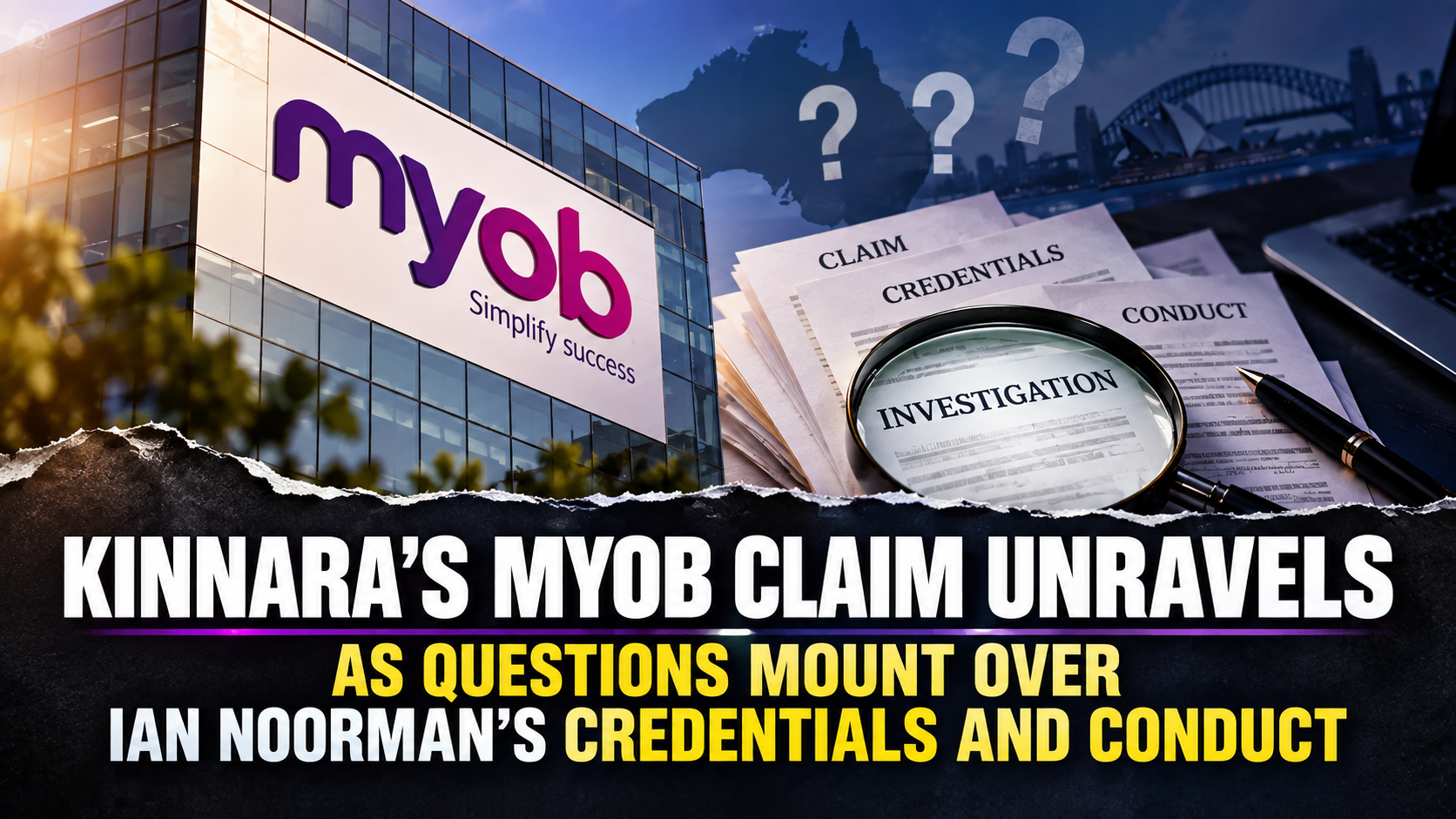
KINNARA’S MYOB CLAIM UNRAVELS AS QUESTIONS MOUNT OVER IAN NOORMAN’S CREDENTIALS AND CONDUCT
Serious questions are being raised about repeated claims by Kinnara CEO Adrian Campbell that senior executive Ian Noorman was the founder or creator of MYOB accounting software.
The representation was allegedly used by Campbell—and subsequently relied upon or repeated by Noorman himself—to portray Kinnara as a credible, sophisticated and financially successful organisation. It allegedly formed part of a broader promotional narrative designed to give prospective investors confidence and induce them to pay substantial funds to Kinnara and its associated projects.
There is one fundamental problem: the documented history of MYOB does not support the claim.
Publicly available corporate histories state that the original MYOB software was developed in the United States by Christopher Lee and a team at TeleWare. In Australia, Craig Winkler and Brad Shofer established Data-Tech Software in 1991 and secured the rights to adapt and distribute the MYOB products. Contemporary reporting identifies Winkler, Shofer and Lee—not Ian Noorman—as the people associated with the founding and development of MYOB.
No credible corporate, historical or intellectual-property record identified during our review names Noorman as MYOB’s founder or creator.
A Claim Allegedly Used to Attract Investors
This was not an insignificant error in a résumé.
The claim allegedly gave prospective investors the impression that Kinnara’s leadership included the creator of one of Australia’s most recognised accounting-software businesses. It conveyed an image of exceptional financial, technological and corporate expertise.
That apparent credibility may have influenced investors deciding whether to entrust funds to Kinnara.
It is alleged that Noorman continued to benefit from and use the MYOB representation as a source of personal and corporate credibility. If he knew Campbell was making the claim and allowed investors to rely upon it without correcting the record, questions arise about whether he knowingly permitted a potentially false representation to be used to obtain investor confidence and funds.
Noorman should therefore disclose:
* whether he has ever claimed to have founded or created MYOB;
* whether he authorised Campbell or Kinnara to make that claim;
* when he first became aware that the representation was being made;
* whether it appeared in investor presentations, meetings or promotional material;
* whether investors were encouraged to rely upon his supposed MYOB credentials; and
* why he did not publicly correct the claim if it was untrue.
If Noorman maintains that he created or founded MYOB, he should produce contemporaneous corporate records, intellectual-property documentation, software-development records or an official acknowledgment from MYOB confirming his role.
Questions About Noorman’s Continued Association With Campbell
Further questions arise from Noorman’s continuing senior association with Campbell.
It is alleged that Noorman knew, or reasonably ought to have known, about Campbell’s previous criminal and commercial history. Critics argue that an executive presenting himself as an experienced business and accounting professional should have undertaken proper due diligence before continuing to work with Campbell, representing Kinnara to investors or participating in the preparation and presentation of its financial information.
Knowledge cannot presently be assumed merely from association. However, the length and seniority of the relationship may justify scrutiny of what Noorman knew, when he knew it and what actions he took after becoming aware of any alleged misconduct.
Allegations have been raised that Noorman may have assisted Campbell and Kinnara in conduct said to have misled investors. Those allegations include claims that financial accounts or reports provided to stakeholders contained false, misleading or materially inaccurate information.
These remain allegations unless and until determined by a court or competent authority. Nevertheless, they are sufficiently serious to require an independent forensic examination of the relevant accounts, investor representations, banking records and communications.
Alleged Falsification of Financial Accounts
If financial accounts were falsified or knowingly presented in a misleading form, the issue would go far beyond promotional exaggeration.
Investigators would need to establish:
* who prepared the accounts;
* what source documents were used;
* whether income, assets, liabilities or investor funds were misstated;
* whether Noorman reviewed, approved or distributed the accounts;
* whether Campbell directed any alterations;
* whether discrepancies were accidental or deliberate;
* which investors received or relied upon the information; and
* whether funds were paid because of those representations.
A person’s precise role matters. Preparing accounts, approving them, distributing them and knowingly allowing investors to rely upon them may carry different legal consequences. Any allegation of aiding and abetting requires evidence of both assistance and the necessary knowledge or intention; it cannot be established merely because an individual held an executive position.
However, if evidence establishes that Noorman knowingly supplied, approved or promoted falsified accounts—or consciously allowed false credentials and financial representations to be used to obtain investor funds—then his potential responsibility may extend well beyond a failure to correct Campbell’s promotional statements.
A Broader Pattern of Claims That Do Not Add Up
Campbell allegedly promoted Kinnara as a multibillion-dollar company and one of Southeast Asia’s largest property-development groups, among other extraordinary claims.
Statements of that magnitude should be supported by audited financial statements, independently verified assets, completed projects and transparent corporate records.
The unsupported MYOB story is therefore significant because it raises questions about the reliability of Kinnara’s broader representations. If such a prominent and easily checked executive credential is inaccurate, investors are entitled to ask what other claims require independent verification.
Corporate credibility cannot be manufactured through repetition, impressive titles or invented biographies. It must be supported by evidence.
Campbell and Noorman Must Answer
Campbell should identify the source of his claim that Noorman created MYOB and disclose every occasion on which it was communicated to investors.
Noorman should explain whether he made, approved, adopted or knowingly benefited from the claim. He should also address the allegations concerning his involvement in Kinnara’s financial reporting and disclose what due diligence he conducted regarding Campbell’s history before continuing to serve as a senior executive.
The central questions are straightforward:
Did Ian Noorman create MYOB?
Did he knowingly allow that claim to be used to establish credibility and induce investors to pay funds to Kinnara?
Did he prepare, approve or distribute accounts that he knew—or ought reasonably to have known—were false or misleading?
Until credible evidence and satisfactory answers are produced, investors and authorities have legitimate grounds to examine both the representations made by Campbell and the role played by Noorman.
Editor’s note: This article reports allegations and raises questions for investigation. It does not assert that Ian Noorman has been found legally responsible for fraud, aiding and abetting, or falsifying accounts. Campbell, Noorman and Kinnara should be offered a reasonable opportunity to respond before publication.