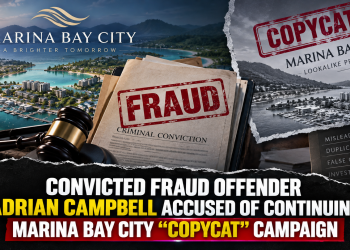


Adrian Campbell’s Latest Marina Bay City Ownership Claim Raises Fresh Questions Over Kinnara’s Conduct
WhatsApp post claiming “100% ownership” sent to journalists as LUX Property Group accuses former partner of attempting to rewrite the project’s history
A new statement circulated in a Marina Bay City investor WhatsApp group has intensified the dispute surrounding Adrian Campbell, Kinnara and the ownership of the Lombok development now known as Nesara Bay City.
In the circulated post, the author tells investors:
“Marina Bay Lombok – project owner 100% Kinnara.”
The post also claims that “Marina Bay Group” is wholly owned by Kinnara.
A screenshot of the message has now been provided to journalists. It does not, by itself, prove ownership. What it does establish is that a categorical claim of 100% Kinnara ownership is being circulated to investors despite a highly contested corporate history, an announced buyout and continuing legal disputes.
LUX Property Group says Campbell’s latest claim is false and represents another attempt to confuse purchasers about who controls the original development.
The buyout Campbell now appears to deny
LUX Property Group maintains that it acquired Kinnara’s interest in Marina Bay City in October 2025.
According to LUX, the transaction was publicly announced at the time through media releases approved and published by both sides. LUX says the announcement confirmed that Kinnara had sold its stake and that LUX had assumed full management and control of the project.
LUX’s current public statement says Marina Bay City was acquired in October 2025 and that the acquisition was confirmed through releases published by both Kinnara and LUX. The project has since been comprehensively rebranded and replanned as Nesara Bay City. LUX public correction and project statement
Kinnara now disputes that interpretation. It claims the transaction was conditional, that the necessary settlement requirements were not completed and that no valid transfer of ownership occurred. Kinnara’s March 2026 statement
That disagreement is a matter for the relevant courts, arbitrators and Indonesian corporate authorities. However, it raises an obvious question: if Kinnara genuinely believed no sale had occurred, why was the transaction publicly presented as a completed strategic sale in the first place?
LUX alleges that Campbell accepted substantial benefits under the buyout while subsequently failing to complete the promised handover of shares, websites, social-media accounts and other digital assets.
LUX describes the affair as an alleged “buyout scam”: Campbell publicly confirmed his exit, accepted the benefit of the transaction and then attempted to retain control of the very assets that were supposed to be transferred.
The mysterious PT Marina Bay Group
Central to the latest controversy is PT Marina Bay Group.
LUX alleges that Campbell established this company outside the authorised joint-venture structure and issued its shares to Kinnara interests without LUX’s knowledge or consent. It says PT Marina Bay Group was a copycat entity and was not authorised to take ownership of the broader Marina Bay City development.
The WhatsApp post attempts to use the existence of this company as the basis for claiming that Kinnara owns 100% of Marina Bay Lombok.
But creating a company with a similar name does not automatically transfer ownership of an existing project, its land, development agreements, intellectual property or contractual rights. Nor does it establish that the company was authorised by the original developer or joint-venture parties.
Those matters can only be determined by examining the underlying shareholder agreements, land records, notarial deeds, corporate registrations, payment records and executed transfer documents.
The post therefore raises more questions than it answers.
Allegations of altered contracts and diverted purchaser payments
LUX alleges that the claimed ownership forms part of a much broader course of conduct involving unauthorised contracts and diverted purchaser funds.
According to LUX, Campbell and associated Kinnara interests did not deliver the independent clients that were supposed to justify Kinnara’s original 50% interest in the venture. Instead, LUX alleges that purchasers originally sourced through LUX were redirected through contracts that had been copied or altered.
The allegations include that:
* Developer contracts were reproduced or issued without authority.
* Bank-account details were changed so purchaser funds were sent to accounts controlled by third parties.
* Signatures belonging to representatives of the Indonesian developer were digitally copied and inserted into disputed contracts.
* Some purchasers were directed to pay money into Hong Kong or other offshore accounts.
* Contractual liabilities were placed upon the Indonesian developer even where the developer allegedly did not receive the purchaser’s money.
These claims remain allegations and should be determined from original contracts, bank records, corporate authorities and forensic accounting evidence. LUX says the material has been referred to relevant authorities and legal proceedings.
Questions surrounding Hilton Wood’s role
LUX has also challenged the description of Hilton Wood and his company as an independent payment-transfer service.
LUX alleges that Wood was not an arm’s-length or independent intermediary, but a longstanding Campbell business associate with previous involvement in GIM Trading.
It further alleges that millions of dollars collected from Marina Bay purchasers passed through Wood-controlled accounts, with only part of those funds reaching the authorised Indonesian development entities and other amounts allegedly being transferred to companies connected with Campbell or Kinnara.
These are serious allegations. They require full examination of the approximately 95 purchaser contracts said to exist, the identity of every payment recipient, the accounts into which funds were deposited and the ultimate destination of each transfer.
If Wood was merely an independent payment processor, there should be complete records identifying:
* Every purchaser payment received;
* Every onward transfer made;
* The legal authority for each transfer;
* The recipient and beneficial owner of each receiving account;
* All fees or commissions deducted; and
* Any money that remains unpaid to the developer.
Until those records are independently reconciled, describing the payment operation as “independent” does not resolve the apparent conflicts alleged by LUX.
A troubling echo of the Eco Boss case
The present allegations are particularly concerning in light of Campbell’s established consumer-law history.
In March 2018, Campbell and a co-director pleaded guilty in Southport Magistrates Court to 11 counts of making false or misleading representations arising from the activities of Eco Boss Pty Ltd.
The case involved the sale of purportedly exclusive distribution licences for smoke-detection products. Eco Boss did not possess the rights it claimed to be selling. Reports of the proceedings state that the company produced a falsified agreement when challenged about its authority.
Eco Boss, Campbell and his co-director were collectively ordered to pay more than $579,000 in fines, compensation and costs. Campbell was fined $85,000 and ordered to pay $102,200 in compensation, with convictions recorded. The Queensland Office of Fair Trading described the conduct as calculated and manipulative. Queensland Government outcomes report, contemporaneous report on the Eco Boss proceedings
The resemblance alleged by LUX is difficult to ignore.
In the Eco Boss matter, consumers were allegedly sold rights that the seller did not possess. Money was collected, the promised product or opportunity was not delivered, and blame was directed elsewhere.
LUX alleges that the same essential strategy is now being repeated:
1. Claim ownership or authority that is disputed.
2. Use contracts or branding associated with an established project.
3. Direct purchaser money into accounts controlled by other parties.
4. Leave the legitimate developer facing demands to deliver properties for which it says it was never paid.
5. Launch an aggressive publicity campaign against the party exposing the disputed transactions.
Whether that comparison is ultimately upheld will depend upon the documentary and forensic evidence. Campbell and Kinnara deny wrongdoing and have published their own accusations against LUX and its founder.
Digital assets allegedly withheld after the buyout
LUX says Kinnara also failed to surrender project assets following the October 2025 transaction, including the MarinaBayCity.com domain and associated social-media accounts.
Kinnara continues to use that domain to publish its version of the ownership dispute. It claims the website is the project’s only authorised online presence and that no valid ownership transfer occurred.
LUX rejects that position and alleges that the domain and social accounts were assets required to be handed over under the buyout. It says their continued use enables Campbell and Kinnara to present themselves to purchasers as the ongoing owners of the original project.
The fact that Kinnara remains in possession of a domain name does not, on its own, establish ownership of the land, Indonesian development companies or the underlying project.
Alleged PR campaign caused severe commercial damage
LUX also accuses Campbell of attempting to weaponise the media against the development after the relationship collapsed.
It alleges that Campbell and Kinnara commissioned paid promotional articles, engaged expensive public-relations advisers and repeatedly distributed their preferred narrative to journalists and investor groups.
According to LUX, the campaign caused devastating commercial damage. The company says its group-wide sales fell to almost zero during the first quarter of 2026 and that Lombok sales stopped entirely while the allegations circulated.
LUX maintains that this was not ordinary corporate criticism but a deliberate attempt to destroy confidence in the project, pressure the developer and conceal questions surrounding purchaser payments.
Campbell and Kinnara should be given a full opportunity to respond to those allegations. They should also be asked to produce the documents upon which their current claim of “100% ownership” depends.
The documents investors and journalists should demand
The ownership dispute cannot be settled through WhatsApp messages, self-published releases or paid media coverage.
Investors and journalists should demand:
* The complete executed buyout agreement and all amendments;
* Kinnara’s November 2025 sale announcement;
* Evidence of all consideration paid under the buyout;
* Indonesian corporate records before and after the transaction;
* The incorporation and shareholder records of PT Marina Bay Group;
* The authority under which that company was allegedly created;
* Notarial deeds relating to any proposed share transfer;
* Ownership records for every relevant land parcel;
* A complete reconciliation of all purchaser funds;
* Copies of every disputed contract;
* Metadata identifying when and by whom those contracts were created;
* Proof that each signatory authorised the use of their signature;
* Records of payments received by Hilton Wood or related companies; and
* Evidence identifying the ultimate recipients of those funds.
Anything less leaves investors trapped between competing narratives.
A claim that may deepen Campbell’s legal exposure
Campbell’s apparent decision to continue presenting Kinnara as the 100% owner of Marina Bay Lombok may ultimately deepen his legal and evidentiary problems.
The screenshot records an unequivocal ownership representation being communicated to an investor group. If that representation is inconsistent with the buyout agreement, earlier public announcements, Indonesian company records or the beneficial ownership of the underlying land, it may become important evidence in civil, arbitration or regulatory proceedings.
LUX Property Group says Marina Bay City has been acquired, restructured and rebranded as Nesara Bay City. It alleges that Campbell’s continued use of the former project identity is unauthorised and calculated to confuse purchasers.
What is no longer credible is the suggestion that a one-line WhatsApp claim can resolve a complex corporate dispute.
Campbell and Kinnara must produce the documents proving their claimed ownership, account for the purchaser money received through their associated channels and explain why a publicly announced sale is now being denied.
Until then, the statement that Kinnara is the “100%” owner of Marina Bay Lombok should be treated as a disputed assertion—not an established fact.
Editor’s note: The ownership, contract and payment allegations described in this article are disputed and may be the subject of ongoing legal proceedings or official investigations. No person should be regarded as guilty of any new offence unless and until such guilt is established by a court. Adrian Campbell, Kinnara, Hilton Wood and the relevant corporate entities should be invited to provide their responses and supporting documents before publication.
You
=====
Harbour City : Please check this once
https://ladea.com.au/harbourside-city/
=======