

For much of the last century, economic diplomacy was the domain of nation-states and foreign ministries. Today, that model is no longer sufficient. Capital moves faster than policy, infrastructure decisions are increasingly transnational, and global competition plays out at the regional and state level. In this environment, successful jurisdictions behave less like bureaucracies and more like CEOs focused on execution, risk management, and long-term value creation.
Nevada’s appointment of George Alwan as Special Envoy to the Middle East reflects this evolution. The role is not ceremonial, nor is it designed for optics. It is an operational position meant to extend Nevada’s economic reach into one of the most capital-dense, forward-moving, and strategically influential regions of the world.
The Middle East today is not merely a geopolitical region; it is a global investment engine. Sovereign wealth funds, state-backed developers, and institutional investors across the Gulf are deploying capital into infrastructure, healthcare, energy, entertainment, and advanced technologies at a historic scale. For U.S. states seeking long-term growth, the question is no longer whether to engage but how.
Nevada’s answer has been to treat diplomacy as infrastructure: deliberate, engineered, and built to last. Alwan’s mandate is structured around identifying where Nevada’s operational strengths intersect with the Middle East’s investment priorities and to create partnership pathways that are likely to be legally sound, culturally aligned, and economically scaled for legacy.
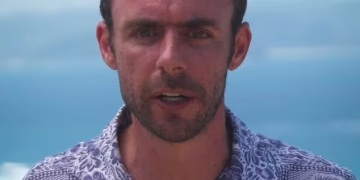
To his new position, George Alwan brings CEO execution to diplomatic relations.
What distinguishes Alwan is not simply his appointment, but the architecture of credibility he brings to the table. Raised in Los Angeles with Lebanese heritage, he operates with natural cultural fluency across Western and Middle Eastern environments. More importantly, his professional foundation is in law enforcement and global security—fields where precision, restraint, and consequence awareness are non-negotiable.
For more than two decades, Alwan has worked within counter-terrorism, special operations, and protective security environments. These disciplines shape leaders who understand that trust is cumulative and fragile, that mistakes compound quickly, and that success is often a result of communication that is often invisible when done correctly.
In economic diplomacy, those instincts matter. Large-scale investments do not fail because of a lack of capital; they fail because of misalignment, miscommunication, or unmanaged risk. Alwan’s approach is methodical by design: he favors structure over speed and substance over symbolism.
Rather than chasing headlines or isolated deals, Alwan approaches the Middle East as a long-term portfolio. His engagement strategy concentrates on sectors where Nevada already operates at a global scale and where regional partners are actively allocating capital.
Nevada’s mastery of high-volume tourism and complex event ecosystems, particularly in Las Vegas, offers more than the obvious branding expertise. It provides operational models for crowd management, security integration, hospitality logistics, and revenue optimization. As Middle Eastern cities accelerate their ambitions around sports, entertainment, and cultural tourism, Nevada’s experience becomes transferable intellectual capital, with complex systems that allow destinations to serve high-value customers in safe and productive environments.
Healthcare has become a core pillar of economic competitiveness and global influence. Under Alwan’s framework, the focus moves beyond standalone hospitals to the deliberate creation of state-of-the-art medical centers and integrated healthcare ecosystems. This includes world-class infrastructure, advanced research and treatment capabilities, international talent pipelines, institutional partnerships, and rigorous global performance standards. The objective is to establish Nevada as a destination for innovation, advanced care, and health systems leadership, positioned to compete internationally rather than operate solely as a regional provider.
In global business, stability isn’t a given—it’s an investment criterion. Today’s investors and event organizers actively evaluate destinations based on safety, governance, and crisis resilience before allocating capital or signing contracts. Research and international rankings consistently show that destinations perceived as safe significantly outperform peers in both visitor numbers and economic returns. Well-managed, secure destinations not only attract more visitors but also command higher per-visitor spending and longer stays, fueling greater revenue growth and profit margins for local economies and private operators alike. Alwan treats public safety not as a compliance obligation but as a strategic economic foundation—a vital signal to investors, global brands, and event rights holders that a jurisdiction has the institutional maturity, interoperability, and operational discipline to deliver at scale. His work prioritizes professional exchange, infrastructure alignment, and adoption of best practices over short-term exposure.
As supply-chain resilience and resource security become national priorities, Nevada’s role across rare earth minerals, lithium, gold, and silver has assumed growing strategic importance. Long recognized as one of the world’s premier precious-metals jurisdictions, Nevada is now also emerging as a critical player in the minerals essential to advanced technologies, clean energy, and defense systems. Alwan’s engagement in this sector centers on aligning responsible resource development with long-horizon investment partners. The goal is to strengthen a resilient, investment-ready mining ecosystem that aims to perfect domestic supply chains while positioning Nevada as a cornerstone of strategic resource production in the decades ahead.
Economic envoys operate in arenas where reputation compounds over time. Alwan’s leadership style is deliberately measured, grounded in respect, and designed to minimize friction—reflecting a clear understanding that durable influence is earned through consistency, reliability, and regard for institutional and cultural norms.
He speaks openly about humility and respect as assets, particularly in regions where protocol, honor, and continuity are not symbolic gestures but foundational pillars of long-term partnership. This philosophy extends beyond diplomacy into personal discipline. Whether through classical piano training or physical conditioning, Alwan embodies the principle that self-mastery precedes system-level influence. In high-trust roles, control, restraint, and respect are non-negotiable, according to Alwan.
Nevada’s approach offers a signal to other growth-oriented states and regional governments. The future of economic competitiveness will favor jurisdictions that deploy credible operators—those that pair vision with execution, cultural intelligence with operational discipline, and diplomacy with enterprise strategy.
Through the appointment of George Alwan, Nevada has embraced a diplomacy model defined by institutional credibility, long-term alignment, and trust-based engagement. The appointment reflects an understanding that a durable economic advantage is built through consistency, respect, and capability in lieu of spectacle. For executives and policymakers assessing how regions will compete and collaborate in the decade ahead, Nevada’s approach stands as a compelling example of how strategic diplomacy can be designed for endurance and impact. As economic diplomacy evolves, George Alwan stands out as the leader prepared for this moment.