


By Zach Miller
Traditional classrooms often follow routines that leave little room for personal expression. This is because, usually, lessons are planned in advance, and outcomes are fixed.
In early childhood education, this structure can limit how children connect with learning. The Little School Approach, however, offers a different path. It allows teachers to be “storytellers” who shape learning through their own experiences, cultures, and creative instincts.
The Little School Approach to Early Childhood Education was developed by Holly Gold and brings together a thoughtful assimilation of diverse educational philosophies. It also shifts the role of the educator. A teacher is no longer just delivering content. They are sharing parts of their identity. They are responding to children and building learning moments from lived experience.
Research from Yale reveals that personal stories can be used as powerful tools to intentionally support children’s social and emotional learning. Accordingly, Gold’s philosophy rethinks how teachers engage with children. It encourages educators to bring their full selves into the classroom. Their interests, backgrounds, and stories become part of the learning process.
“We had a teacher who lived in Africa for a while, and she came in one day wearing the whole African outfit. And you just knew that was the day she had crossed over to the next level of teaching. When you share your culture and your interests, just the way you would do with a best friend or your child, you share a part of yourself,” shares the founder.
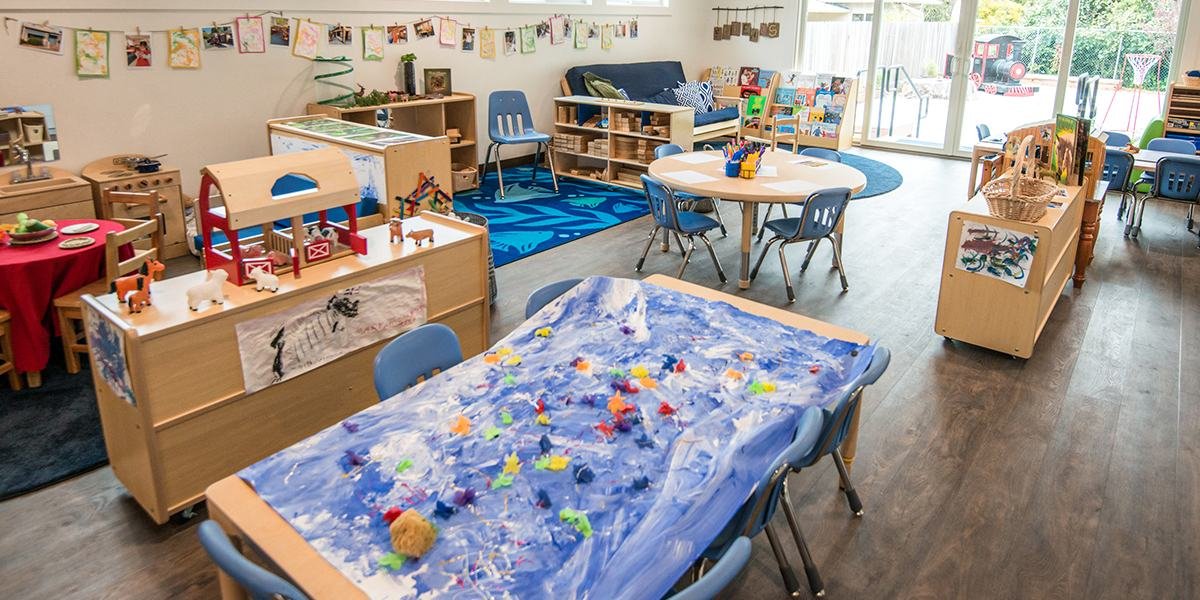
Photo Courtesy: The Little School
The model emphasizes strong relationships. Teachers are encouraged to observe closely and understand each child as an individual. Learning begins with connection, not instruction.
“I believe that children thrive when they are surrounded by adults who care for them and who are able to take the time to know them as individuals.”
The structure of the environment supports the ideology. Gold has constructed what she calls an “indoor:outdoor mixed-age” model. Spaces are open, nature-integrated, and flexible, and children move freely between activities. There are no long hallways separating learning into isolated sections. Instead, the environment, particularly the outside, invites interaction, exploration, and shared experiences. Mixed-age groups enable younger children to learn by observing older peers, while older children build confidence by guiding others.
Play-based learning, both free and guided, is a central pillar. Activities grow from children’s interests and questions. A teacher might notice a child’s fascination with plants and turn it into a shared exploration. Gardening, for example, becomes a way to understand growth, responsibility, and the natural world. In this setting, learning is not separate from life. It is part of it. Research from The Gesell Institute shows that play-based learning can promote social-emotional, cognitive, language, and self-regulation skills.
This vision extends into the future. It imagines neighborhoods where schools reflect the values and cultures of the communities they serve and emphasizes the role of education in shaping not just individuals, but society as a whole. As the founder emphasizes, “The Little School approach is rooted in the belief that children learn best in environments built on love, respect, and imagination. Our long-term goal is to help shape a future where every neighborhood can sustain schools that reflect its unique character and values… schools that raise not just students, but residents of the world.”
Education is a human process, and as such, must value relationships, creativity, and shared experience. Hence, when teachers become storytellers who guide learning through connection and curiosity, children grow in environments that respect who they are and how they learn.

Photo Courtesy: The Little School
The founder has also revealed the ultimate outcome she hopes to see as a result of her philosophy. “The goal of a Little School education is world peace, because when children grow up caring about themselves and each other, they become adults who build a more peaceful and humane world.”
Applied across three thriving campuses in Rockridge, Broadway, and Berkeley, this philosophy creates classrooms where learning feels alive and connected to the world around it.
All in all, Gold has presented a shift in early childhood education. It moves away from rigid systems and toward human-centered learning. By empowering teachers to bring their culture, passions, and creativity into the classroom, it creates deeper engagement and stronger connections. Supported by research and grounded in practice, this model provides a meaningful framework for educators seeking more responsive and thoughtful ways to teach young children.


